
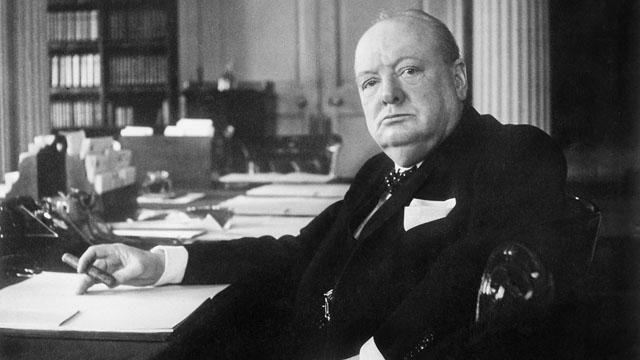
Churchill, the Jews, and Western Civilisation
An important new book examines these vital topics:
Countless books and articles have been written on the three topics found in my title. One brand new book deals with all these topics and more. Churchill’s Secular Creed: Empire, Zionism, and Islam’s Complicity in the Holocaust by Ibn Warraq (World Encounter Institute/New English Review Press, 2026) is well worth reading.
He is a global authority on Islam, and given the current state of play in the Middle East, his incisive commentary is always of great value, especially with the rise of Woke Right. Folks like Tucker Carlson, Candace Owens and Nick Fuentes all rail against Trump and MAGA, Israel and the Jews, the West and Christianity, while increasingly singing the praises of Islam.
Many in the Woke Right also love to hate on great leaders of the recent past, including Winston Churchill. They even claim that Churchill was in the wrong and Hitler was in the right! Some of them are neo-isolationists, but most are simply Jew-haters and Israelphobes. Given that Churchill was a Zionist, this explains their hatred of him. So this book is especially needed at a time like this.
Western civilisation
Let me share some quotes from him on the importance of the West, and the importance of the Jews. Churchill long saw the West as being superior in various ways, and he saw that he had some sort of providential role to play in promoting and maintaining Western civilisation. Just one extended quote from Warraq:
Churchill certainly was not a relativist, and did not believe that all civilisations, societies and cultures were equally praiseworthy. Many cultures outside the West had morally unacceptable customs. As philosopher Anthony Quinton put it: Headhunting, cannibalism, slavery, infanticide, female circumcision, and the burning of widows on their husband’s funeral pyres are practises which surely fall outside the range of tolerance of moral disagreement. One might not feel justified in invading a country in order to put them down, but once installed in power there, it would be morally unacceptable to endorse them, by allowing them to continue.”
With his boundless civilisational self-confidence, Churchill firmly believed that Britain and Europe could teach the world the art of government, and the science of economics. When one considers the advances in medicine, and science in general, that Britain and Europe had made up to the nineteenth century and of course, the efflorescence of Western Culture, that gave the world her literature, music, art and architecture, one understands Churchill’s sense of superiority and his pride in the British Empire. The great ideas of the West – rationalism, self-criticism, the disinterested search for truth, the separation of church and state, the rule of law, equality before the law, freedom of conscience and expression, human rights, liberal democracy – constitute an achievement of which no other civilisation can boast. These western values are the basis of the West’s self-evident economic, social, political, and cultural success, and are clearly superior to any other set of values devised by mankind. As Jonathan Sumption in an article and the Spectator put it, it would be simply “silly to deny that in the two centuries before the second world war, Europe was culturally, technically, and economically the most creative region of the world and the source of most things that have made it a better place.” Everything from clocks to sewing machines, vaccines to surgical anaesthesia, thermometers to the first cardiac catheterization, and so on, were some of the inventions and accomplishments up to the end of the nineteenth century of British scientists, and engineers, scientists such as that undisputed genius Isaac Newton [1643-1727] who not only discovered the fundamental laws of motion, and gravity, but also invented the calculus; Michael Faraday [1791-1867], whose research led to our understanding of electromagnetism . . . . If we were to include all the European contributions to science, economics, engineering, medicine, and the arts, we would need a full-length monograph of several thousand pages to cover them. By contrast, what exactly are the contributions to civilization and progress of Africa south of the Sahara? For that matter, what have been the contributions of the Islamic world since the 12th century? (pp. 197-198)
Israel and the Jews
Important works have already been penned on this issue, such as Martin Gilbert’s 2007 book, Churchill and the Jews, which this book interacts with. Winston’s father, Lord Randolph was well-known as a friend of the Jews, and so was he. Writes Warraq:
Like Disraeli, Winston Churchill thought of the Jews as “the most formidable and most remarkable race which has ever appeared in the world. …We owe to the Jews in the Christian a system of ethics which, even if it were entirely separated from the supernatural, would be incomparably the most precious possession of mankind, worth in fact the fruits of all other wisdom and learning put together. On that system and by that faith there has been built out of the wreck of the Roman Empire the whole of our existing civilization.” (p. 302)
He continues:
Churchill understood the central contributions of the Jews to the evolution of modern civilisation, especially their monotheism and ethics which shaped Western Civilisation. He wrote an article about Moses for the Sunday Chronicle, which was published on 8 November, 1931. Unconcerned by scholarly scepticism about the historicity of Moses, Churchill describes him as “one of the greatest of human beings, with the most decisive leap-forward ever discernible in the human story.” Of the code of ethics that Moses received on Mount Sinai, Churchill said: “This wandering tribe, in many respects indistinguishable from numberless nomadic communities, grasped and proclaimed an idea of which all the genius of Greece and all the power of Rome were incapable.”
Moses himself “was the greatest of the prophets, who spoke in person to the God of Israel; he was the national hero who led the chosen people out of the land of bondage, through the perils of the wilderness, and brought them to the very threshold of the Promised Land; he was the supreme law-giver, who received from God that remarkable code upon which the religious, moral, and social life of the nation was so securely fastened. Tradition lastly ascribed to him the authorship of the whole Pentateuch, and the mystery that surrounded his death added to his prestige.” (pp. 302-303)


And of course Churchill led the way in ensuring that the Jews had a national homeland:
Churchill always claimed he had been a zealous Zionist for a very long time. He certainly revealed his love of Jews early in his life, as when he cheered when Emile Zola defended Dreyfus. Churchill also proposed to have the name of Oliver Cromwell for one of the four new battleships finished in 1911, because he admired Cromwell for admitting the Jews into Britain – Churchill failed to convince the King. (p. 304)
Warraq examines his activities over decades leading up to the creation of the modern state of Israel. He received much criticism for his strong support of the 1917 Balfour Declaration. As he replied to critics in 1921:
“You have asked me in the first place to repudiate the Balfour Declaration and to veto immigration of Jews into Palestine. It is not in my power to do so, nor, if it were in my power, would it be my wish. The British Government have passed their word, by the mouth of Mr Balfour, that they will favour the establishment of a National Home for Jews in Palestine, and that inevitably involves the immigration of Jews into the country. This declaration of Mr Balfour and of the British Government has been ratified by the Allied Powers, who have been victorious in the Great War; and it was a declaration made while the war was still in progress, while victory and defeat hung in the balance. It must therefore be regarded as one of the facts definitely established by the triumphant conclusion of the Great War.” (pp. 307-308)
Concerning the WWII, Warraq states:
At the outset, Churchill was determined to do the utmost to help the Jews, and conveyed this message to Chaim Weizmann, quoting Disraeli’s dictum that the Lord deals with the nations as the nations deal with the Jews. Unfortunately, Churchill had to deal with the antisemitism of British officials, and the increasing antisemitism of the British public, and even with the general indifference of the US government, including President Franklin Roosevelt. Of course, the priority for Churchill was winning the War… (p. 320)
He continues:
On his first war-time meeting with President Roosevelt in August 1941, Churchill re-iterated his concern for the Jewish people, and told Roosevelt: “I am strongly wedded to the Zionist policy, of which I was one of the authors.” Roosevelt had presented Churchill with his vision of the postwar world, when Britain and the United States would pledge themselves to “respect the right of all peoples to choose the form of government under which they will live.” Churchill agreed, but not with regard to the Arabs of Palestine, explaining to the President that “the Arabs might claim by majority that they could expel the Jews from Palestine, or at any rate forbid all future immigration.”
Roosevelt was not convinced, but Churchill persevered. In the meeting of the War Cabinet on 2 October 1941, he insisted that if Britain and the United States emerge victorious from the war, the creation of a great Jewish state in Palestine would inevitably be one of the matters to be discussed at the Peace Conference.
For Churchill saw, quite correctly and clearly that the Jewish fate in Europe and the Jewish future in Palestine were inextricably linked. He intervened whenever he was made aware of the need to allow Jewish immigrants to remain in Palestine when their lack of Palestine Certificates made them liable to be deported…. (p. 323)
In July of 1945 the Labour Party won the general election. Any former support of Zionism they once had dissipated. Writes Warraq:
On 24 May 1948, Britain’s Palestine mandate ended, and on the same day, David Ben-Gurion proclaimed the independence and name of the State of Israel. Both the United States and the Soviet Union recognised Israel straightaway, but Great Britain did not. Within hours, five armies invaded Israel from Lebanon, Syria, Transjordan and Egypt, with Iraqi troops in support. These forces included the Arab Legion, which was led by British officers, and which opened fire on the Jewish quarter of the Old City of Jerusalem, killing several hundred Jews. Churchill immediately drafted a press statement, expressing his dismay at the fact that “forty British officers, armed with British equipment and financed by British subsidy, had fired on the Jewish quarter of Jerusalem”….
In December 1948, the Labour Government still refused to recognise Israel, and Churchill was compelled to speak out in the House of Commons, and pointed out that nineteen countries had already recognised Israel, while “we, who still have many interests, duties and memories in Palestine and the Middle East and who have played the directing part over so many years, would be foolish in the last degree to be left maintaining a sulky boycott.” Prime Minister Attlee and Foreign Secretary Bevins stubbornly stuck to their negative decision. (pp. 342-343)
Britain finally recognised the State of Israel in April of 1950. One last quote:
On 30 July 1951, Churchill spoke in the House of Commons, always criticising Labour Government’s hostile attitude to Israel while being soft on the Arabs, as when the latter closed the Suez Canal to Israeli ships. And when he again became Prime Minister just short of his 77th birthday on 26 October 1951, Churchill thanked his old friend Weizmann for his letter of congratulation: “The wonderful exertions which Israel is making in these times of difficulty are cheering to an old Zionist like me. I trust you may work in with Jordan and the rest of the Moslem world. With true comradeship there will be enough for all. Every good wish, my old friend.”
Whenever the occasion arose, Churchill was ready to praise the achievements of the Jewish state, emphasising his part in her creation, and the fact that he had been a Zionist at least since the Balfour Declaration. (p. 345)
Note: See this companion article, also based on the new Warraq book, dealing with Churchill, Christianity, and Islam: https://billmuehlenberg.com/2026/09/27/churchill-islam-and-christianity/
[2052 words]

Churchill is generally credited with saving the West for his non-appeasement with emerging Nazis. Ironically, his Zionism would be seen by certain members of the present Australian Government as unenlightened.
Yes correct Russell.
The present Australian Government are the creepy left.
Quite right Christopher.